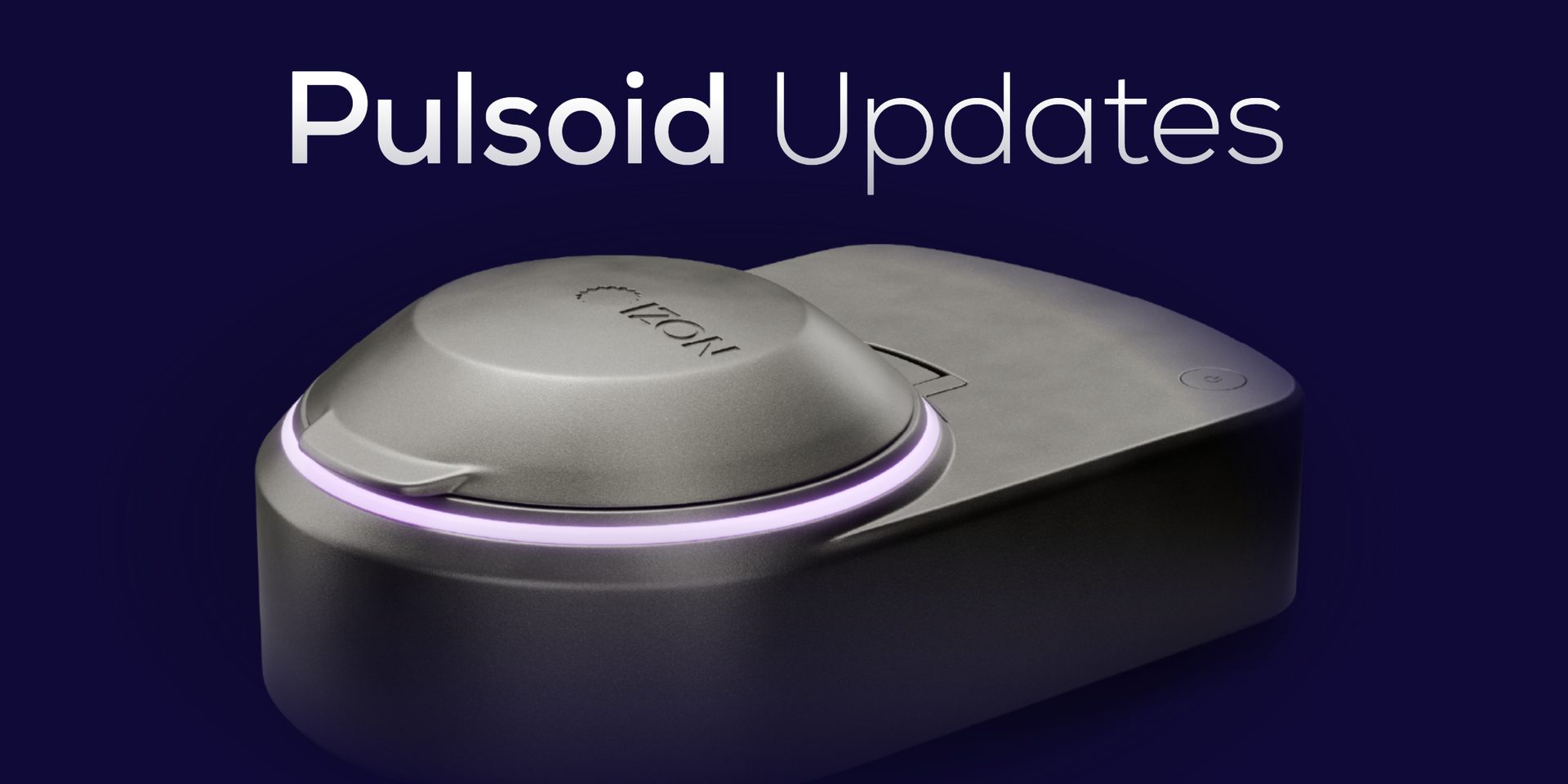


In February 2026, we launched the Pulsoid to overcome the historical trade-off between accuracy and usability in nanoparticle measurement. Today we’re announcing its first major update: new software takes its lower limit down to 30 nm, and a new chip for larger particles extends its range up to 210 nm. Together, these updates make the Pulsoid well suited to measuring extracellular vesicles (EVs) and bacteriophages, while enabling faster, simpler lipid nanoparticle (LNP) measurements.
Pulsoid update
What’s new in this update
Measures down to 30 nm
New software gives a higher signal-to-noise ratio, so the Pulsoid now measures particles as small as 30 nm. More of the small end of LNP and EV populations is now captured, giving more complete size, concentration and zeta potential data.
A new chip for larger particles
P5T measures 45–210 nm, so together the two chips cover 30–210 nm.
Smoother runs
P5T’s larger nanopore makes it easier and faster to run, and it still measures down to 45 nm. It’s now the chip we recommend for most Pulsoid users.
Broader applications
The Pulsoid is now well suited to measuring EVs and bacteriophage, as well as LNPs.
Faster data handling
IDS 2.6.0 imports and exports data faster.


What is the Pulsoid?
The Pulsoid measures particles one at a time as they pass through a fixed nanopore, providing information about their size (volume and diameter), concentration and zeta potential. We call this Nanopore Pulse Sensing (NPS).
Measuring particle by particle reveals subpopulations that ensemble methods cannot resolve. With minimal day-to-day maintenance and a workflow new users pick up quickly, the Pulsoid fits easily into routine lab work.
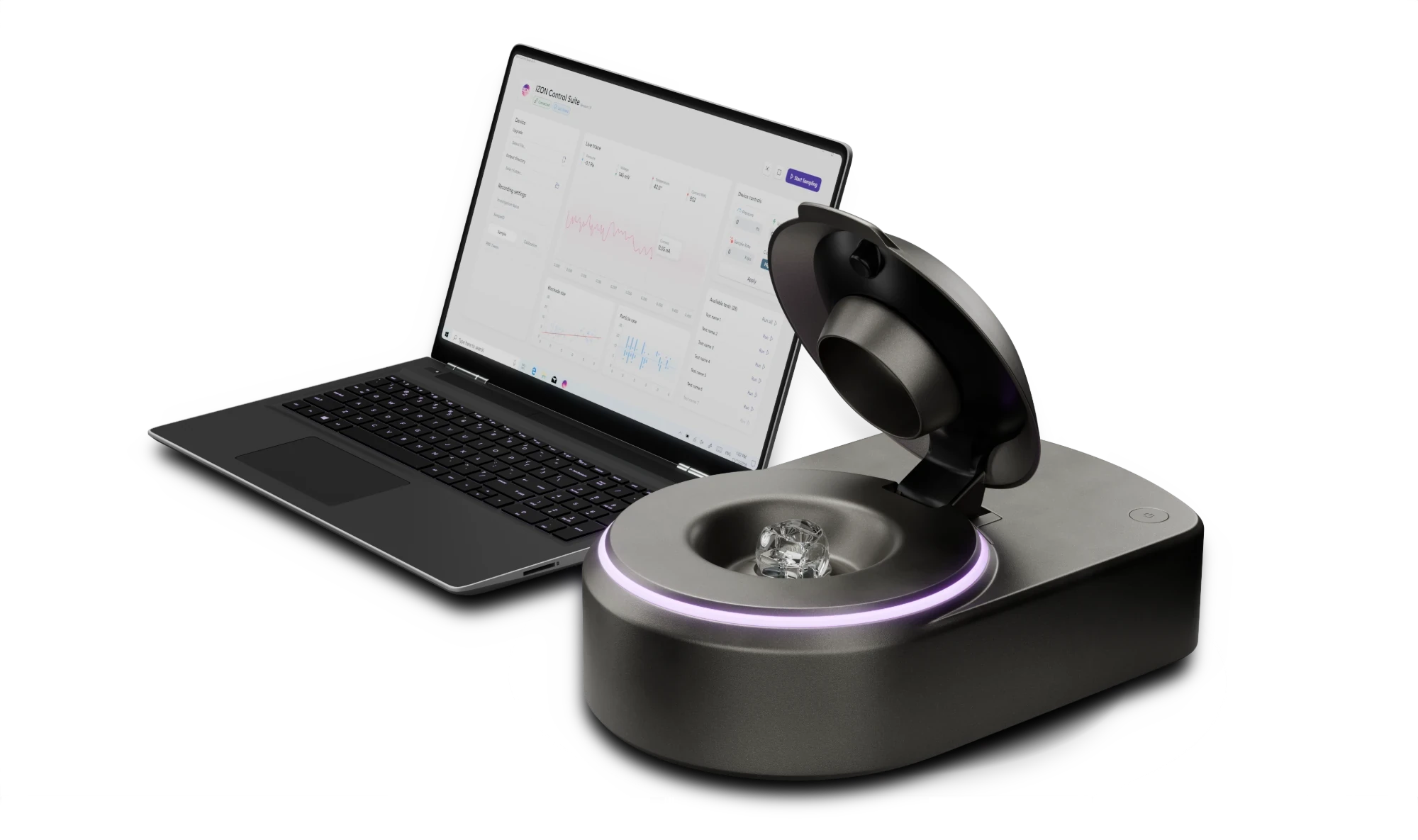

Pulsoid Control SuiteSize, concentration and zeta potential
Fluid cell and nanopore chipTwo chips cover 30–210 nm
High resolution, low maintenanceNo sample tubing, easy to clean
- 1Pulsoid Control SuiteSize, concentration and zeta potential
- 2Fluid cell and nanopore chipTwo chips cover 30–210 nm
- 3High resolution, low maintenanceNo sample tubing, easy to clean
See more of your smallest particles, down to 30 nm
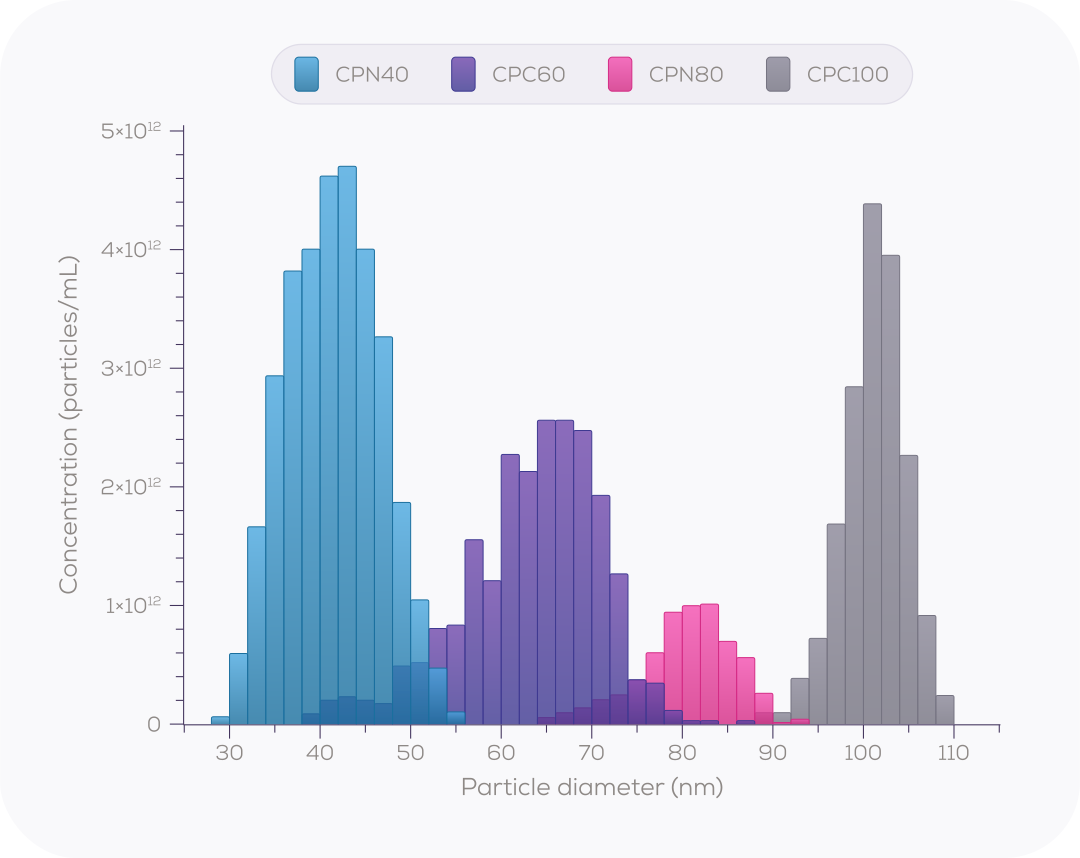
Our latest software releases, Pulsoid Control Suite (PCS) 1.4.0 and Izon Data Suite 2 (IDS) 2.6.0, give a higher signal-to-noise ratio. Small particles now stand out more clearly from background noise, so the Pulsoid's existing chip measures particles as small as 30 nm, with no change to the chip itself.
In practice, a 40 nm calibration standard (CPN40), which sat at the edge of the previous range, now sits comfortably within it.
Measure larger particles, faster and more easily
P5T is our new standard Pulsoid chip. It has a larger nanopore than P4T (previously known as SC80), so it’s easier and faster to run, and the higher signal-to-noise ratio of the new software means it still measures particles down to 45 nm. Its upper limit of 210 nm suits samples with a broad spread of sizes, such as EVs and unpurified bacteriophage, whose larger particles would fall outside P4T's 140 nm limit.
P5T chips are available to order through our online store or your local Izon contact.
What the update means for LNPs, EVs and bacteriophage
Lipid nanoparticles (LNPs)
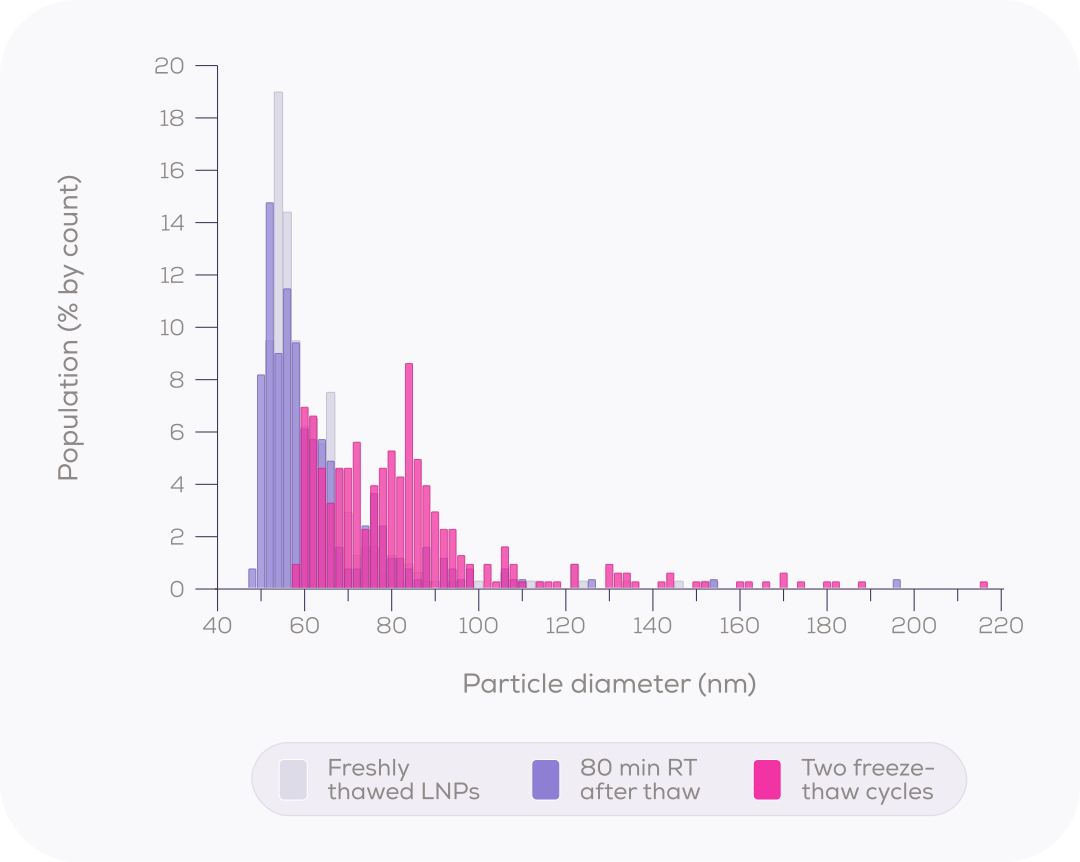
The Pulsoid is now even better suited to LNP characterisation. With P5T, measurements run more smoothly through formulation, scale-up and storage. And because the Pulsoid measures size, concentration and surface charge at the single-particle level, it’s sensitive to small changes: aggregation, instability or processing effects show up directly, even when an ensemble mean barely moves. That makes it easier to compare batches and catch problems early.
Extracellular vesicles (EVs)
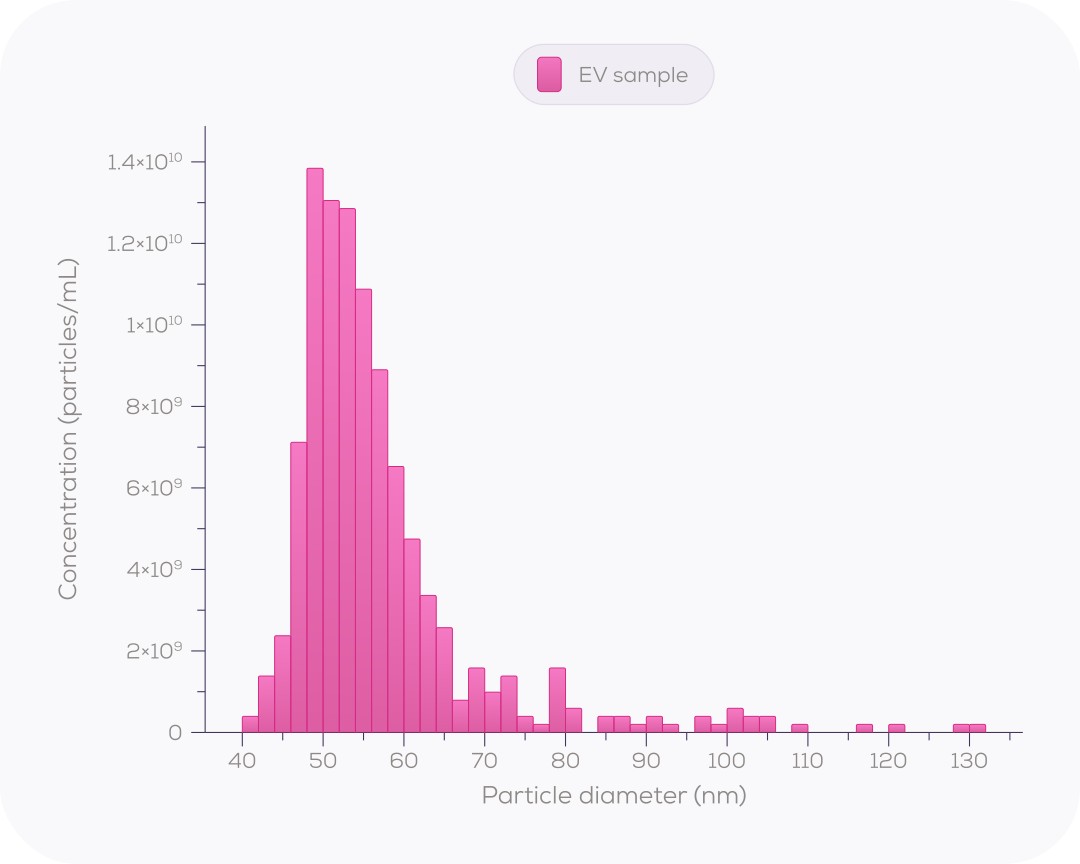
The Pulsoid is now well suited to EV characterisation. High-resolution size and concentration measurements help you standardise what goes into downstream assays or doses, and show whether an isolation has produced what you expect or let larger particles and aggregates through. Measuring single-particle zeta potential alongside size lets you follow changes to the vesicle surface, for example after labelling, loading or engineering. And because it needs only 65 µL of sample, you can characterise precious preparations and compare them from batch to batch.
Bacteriophage
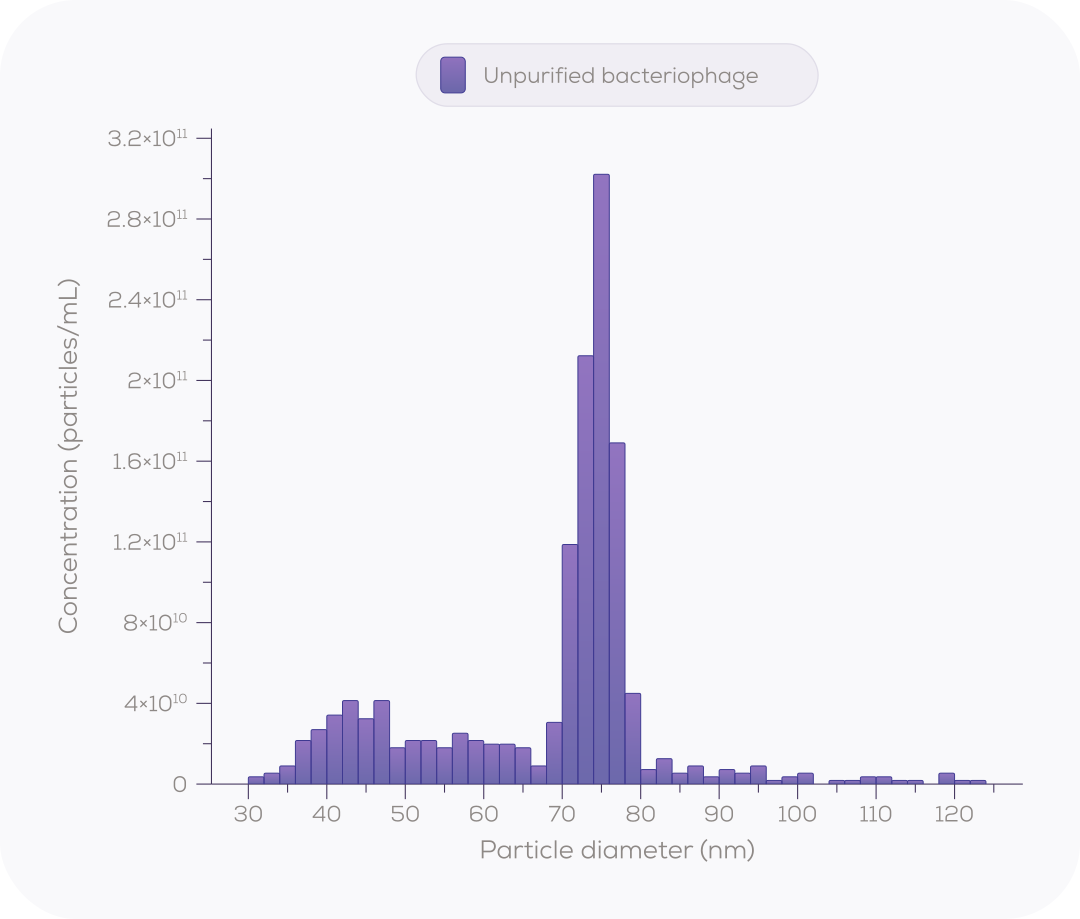
The Pulsoid is now well suited to phage therapy and phage research. Phage particles sit well within the new range, and P5T’s higher upper limit leaves room for the larger particles that unpurified samples often contain. Measuring each particle lets you confirm that intact phage are present, and see their size, before a sample has been purified. That helps you check preparations early, before investing time in purification, and track consistency between batches.
Bacteriophage can be tricky to size. Many aren’t spherical, with a distinct head and tail. DLS assumes spherical particles and averages the whole sample, so larger particles dominate the signal and a phage population can easily be blurred by the background. The Pulsoid measures each particle’s volume directly as it passes through the nanopore, with no shape assumed, so distinct populations stay distinct.
In data from Professor Wojciech Chrzanowski’s lab in Sydney, an unpurified bacteriophage sample gave a sharp peak at about 75 nm, clearly separated from a smaller background population.
“Pulsoid has been particularly valuable for analysing complex, non-spherical particle systems such as bacteriophages and hybrid conjugates with extracellular vesicles and nanoparticles. Beyond particle sizing, it provides access to particle volume, aspect ratio and single-particle zeta potential measurements, delivering information that is difficult to obtain reliably with conventional techniques.”

Professor Wojciech Chrzanowski
Sydney Pharmacy School, The University of Sydney
See what the Pulsoid can do with your samples
Request a demo to see the Pulsoid in action and talk through your samples with our team. We built the Pulsoid to make high-resolution, single-particle data easier to get, and this update extends that to a wider range of samples.
FAQs
How does the Pulsoid compare with DLS?
Dynamic light scattering (DLS) estimates an average size from light scattered by the whole sample. Large particles scatter far more light than small ones, so DLS is very inaccurate for polydisperse samples. The Pulsoid measures each particle’s volume as it passes through the nanopore, so subpopulations are resolved rather than averaged.
How does the Pulsoid compare with NTA?
Nanoparticle tracking analysis (NTA) sizes particles indirectly, from their motion in camera images, and small, faint particles can be missed. The Pulsoid measures each particle’s volume directly and can also measure zeta potential at the single-particle level. It needs less day-to-day maintenance, with no tubing to flush between samples.
What happened to the SC80 chip?
SC80 has been renamed P4T. It’s the same chip, and with the latest software it now measures particles from 30 to 140 nm. Pulsoid chip names now follow a simple pattern: P, a number and a letter, where a higher number means the chip measures larger particles.
Which Pulsoid chip should I use?
We recommend starting with P5T unless your particles are smaller than about 45 nm. Between them, the two chips cover 30 to 210 nm.
How do I update my Pulsoid?
You'll need the latest software to measure down to 30 nm:
- The latest version of the Pulsoid Control Suite (PCS, used to run the Pulsoid) is PCS 1.4.0: How do I download the latest Pulsoid Control Suite software?
- The latest version of the Izon Data Suite 2 (IDS2, used for data analysis) is IDS 2.6.0: How do I download the latest Izon Data Suite software release?
Order P5T chips through our online store or contact your local Izon team.
Pulsoid specifications
*Time per sample is for several samples measured in one session. Measurement time varies with sample characteristics.