


Measure Particle Size, Concentration & Zeta Potential with Unparalleled Precision
Tunable Resistive Pulse Sensing (TRPS) is a single-particle measurement technique for nanoparticles ranging from 40 nm to 11 µm. TRPS measures individual particle size, concentration, and zeta potential with precision and accuracy beyond that of commonly used light scattering techniques, which provide bulk estimates. TRPS is suitable for various biological samples, including exosomes/extracellular vesicles, virus-like particles, lipid nanoparticles, and other biopharmaceuticals.

Measure individual exosomes, extracellullar vesicles and nanoparticles from 40 nm to 11 µm.
Every particle is counted as it passes through the pore, so concentration is measured directly, not estimated.
Precisely measure the zeta potential and size of each particle in your sample.
Measure Individual Particles With Confidence
The precision, resolution and accuracy of size measurement in Tunable Resistive Pulse Sensing (TRPS) is unmatched by any other nanoparticle analysis technique. TRPS measures nanoparticles suspended in electrolytes on a particle-by-particle basis as they pass through a tunable nanopore. When particles pass through they momentarily disrupt the electrical current in the pore, which creates a blockade. The dimensions and frequency of these blockades are used to determine particle size, concentration and zeta potential. Every particle measured is compared to a set of NIST-traceable calibration particles of known size, which ensures accuracy and repeatability.
Learn how TRPS worksWhy Use Tunable Resistive Pulse Sensing?
01
Tunable Resistive Pulse Sensing (TRPS) is a true single-particle measurement technique that provides far greater resolution over ensemble techniques.
02
Reproducibility is enabled through the use of standardised NIST-traceable calibration particles.
03
Automated data processing is achieved via a user-friendly data visualisation interface.
04
Unlike other techniques, TRPS measurements do not rely on prior knowledge of the optical properties of particles or the dispersant.
05
Parameters are adjusted to maximise the signal-to-noise ratio and are monitored during calibration and sample measurement to ensure high-quality data.
Concentration You Can Count On
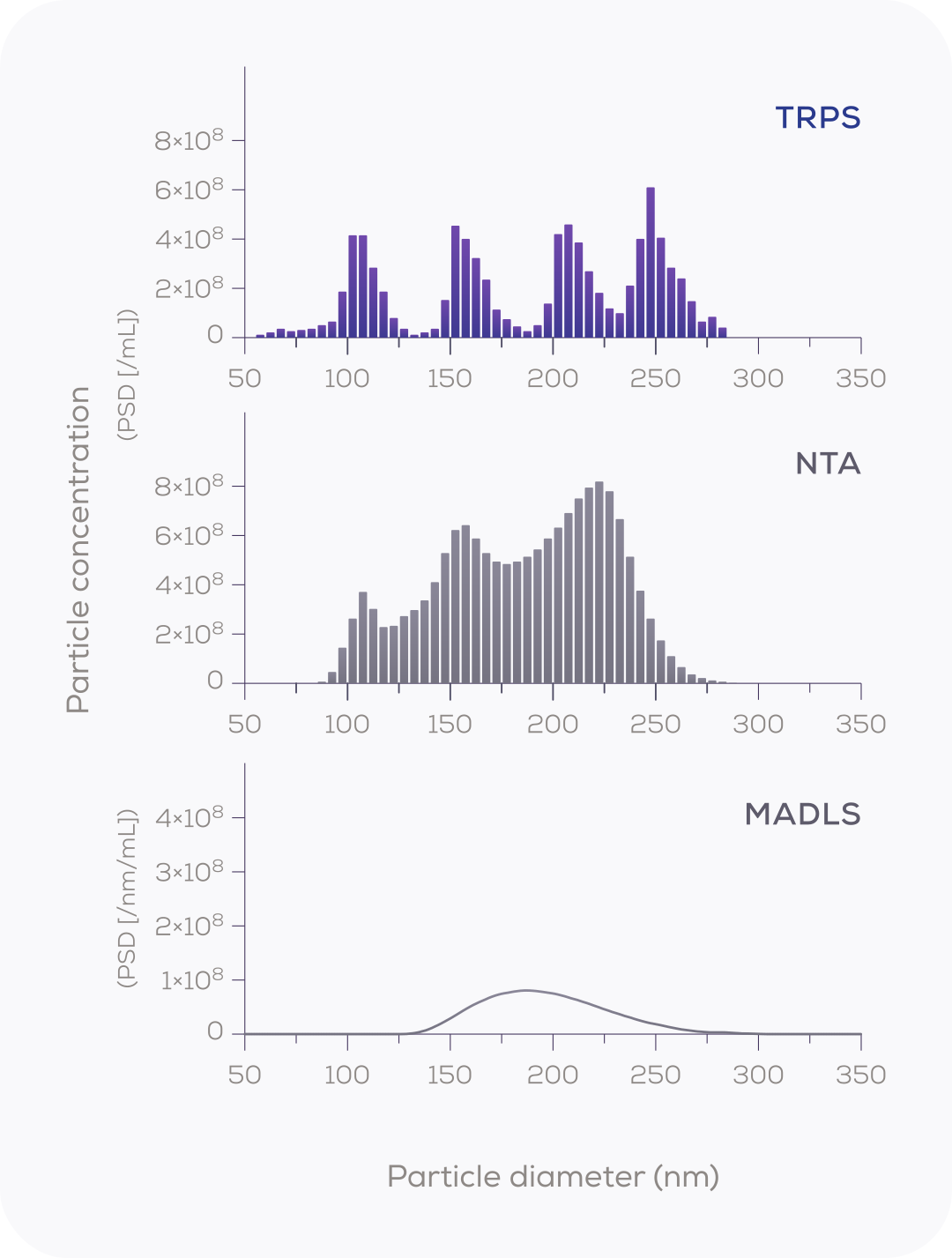
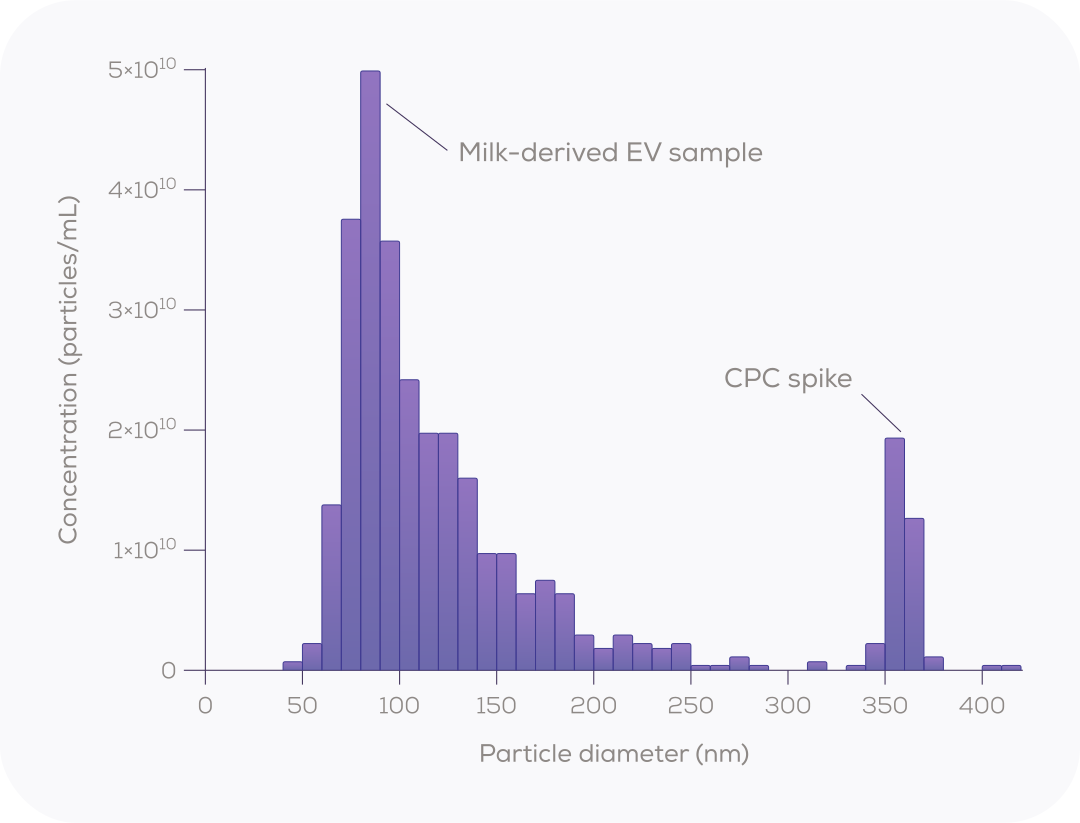
Using Tunable Resistive Pulse Sensing (TRPS), you can simultaneously measure particle size and concentration. As particles individually pass through a nanopore, a blockade is created. The magnitude of the blockade is directly proportional to particle size while the frequency of the blockades is used to determine concentration. TRPS can distinguish multiple subpopulations with high resolution, which is an important capability for fields working with polydisperse samples, such as extracellular vesicle (EV) research.
Learn more about size and concentrationSingle-Particle Zeta Potential Measurement
With Tunable Resistive Pulse Sensing (TRPS) you can measure particle size and zeta potential (or surface charge) simultaneously. TRPS measures each particle individually ensuring highly precise data collection, a powerful new approach for life sciences.
The single-particle approach used by TRPS makes it much more precise than ensemble approaches, such as PALS.
Learn more about zeta potential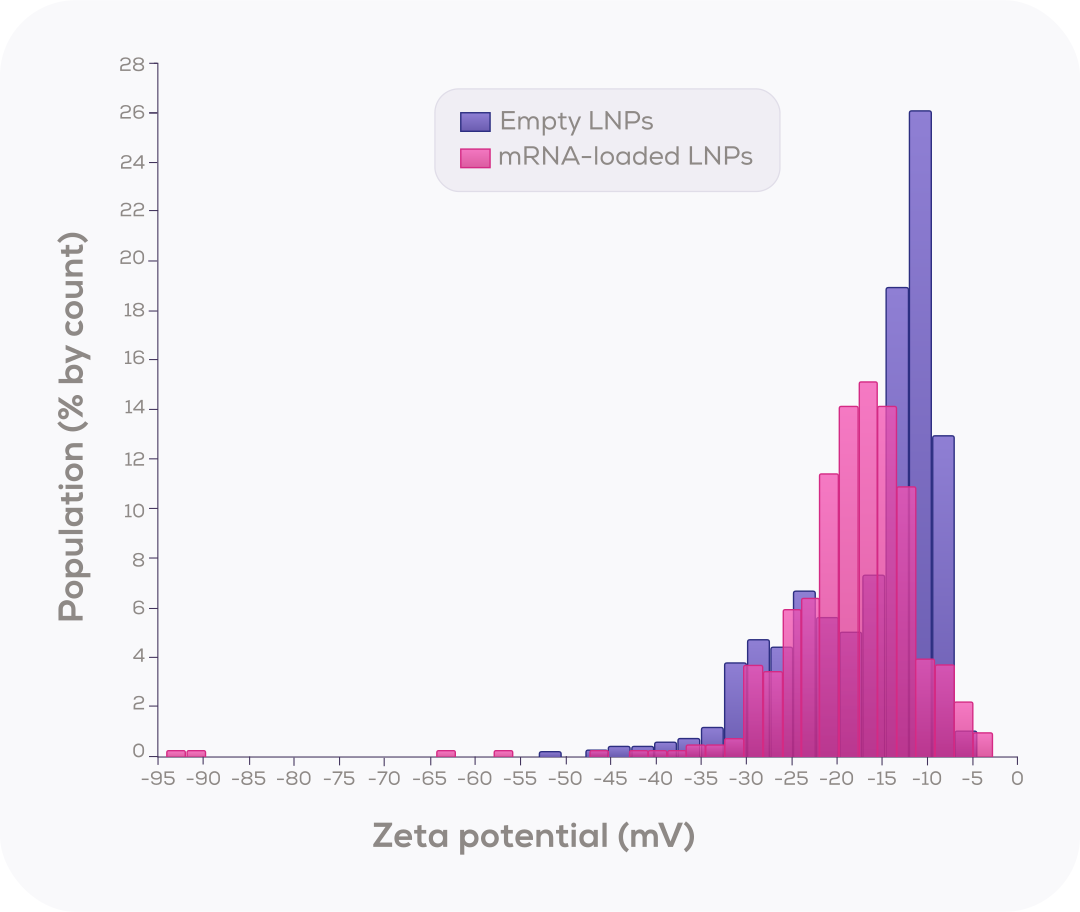
Tunable Resistive Pulse Sensing: Bringing Resolution to Particle Characterisation
TRPS is used in a wide range of applications including exosomes/extracellular vesicles, viruses and virus-like-particles, nanomedicine and other heterogenous nanoparticles. Select your field to read relevant publications and case studies.
Nanomedicine
A comprehensive measurement suite for nanosized drug products.
Extracellular Vesicles
Combine with qEV isolation for fast, easy and pure extracellular vesicle isolation. Accurate and dependable extracellular vesicle measurement down to 40nm.
Vaccine and Virus Formulation
Truly quantitative measurement of total viral titre.
The Exoid: Successor of the qNano Gold
The Exoid is Izon’s Tunable Resistive Pulse Sensing (TRPS) system. Unlike with the qNano Gold, where parameters were adjusted manually, pressure, voltage and pore stretch are adjusted directly from your Exoid-connected device. Significant hardware improvements reduce noise levels significantly over the qNano, meaning that smaller particles can be measured more reliably. The Exoid also has a clean user interface which provides guidance throughout the setup and measurement process.
Learn more about the ExoidSkill Required for Insightful, Reliable Nanoparticle Measurements
Many physical characterisation methods on the market are rapid and require very little effort and skill. However, they do not have the resolving power required for complex samples containing particles of different sizes. Systematic, comparative studies have shown the low resolving capability of these techniques, and the relatively low repeatability compared to Tunable Resistive Pulse Sensing (TRPS). In contrast, TRPS provides precision via its single-particle nature combined with the use of calibration particles and active monitoring by the user. Even though proper sample preparation, skill, and effort are required for TRPS measurements – particularly for the measurement of particles at the lower end of the size range – it’s the only way forward if you want repeatable data on heterogenous samples containing small particles.

Start a Conversation About Your Research


Resources

Can I test my samples before buying an Exoid?
Yes. Get in touch with your local Izon sales representative to arrange an Exoid demonstration and discuss the possibility of measuring your own samples as part of the demo. This is a great way to see how the Exoid performs with your samples before making a purchase. We also offer a sample measurement service in the US and Europe, providing size, concentration and zeta potential data. Leasing options are also available.
What training and support come with the Exoid?
Every Exoid includes training and ongoing support from Izon’s application specialists, plus access to user manuals, software updates and an online support centre. Software upgrades are included as part of your Exoid package.
How does TRPS compare with NTA and DLS?
TRPS measures each particle individually as it passes through a nanopore, so results aren’t skewed by a few large particles the way light-scattering methods can be. It also measures zeta potential for every particle, giving a more complete picture of complex, mixed samples. See how TRPS works.
What is the difference between the Pulsoid and the Exoid?
The Pulsoid uses a fixed, solid-state silicon nanopore, while the Exoid uses a tunable polymer nanopore (TRPS). The Pulsoid offers faster setup and measurement, more consistent results between users, and the ability to measure particles as small as 30 nm. The Exoid covers a wider overall size range and lower concentrations, making it suited to larger or mixed samples. Talk to us about which suits your research.